Recipe for Renewal: How Bread & Roses Training Kitchen Gave Me a Second Chance
From the chaos of addiction and prison cells to the order of a professional kitchen, Chef Uri has rewritten his life story. Through St. Joseph Center’s Bread & Roses Training Kitchen and his recovery community at Beit T’Shuvah, he discovered accountability, confidence, and a second chance to turn his passion for cooking into purpose.
For a drug treatment facility, the kitchen here at Beit T’Shuvah ain’t too shabby. We have almost everything you’d want in a commercial kitchen, minus a flattop or air fryer. But maybe that’s not the worst thing—otherwise, I’d have residents banging at my door trying to fry everything from Oreos to bagels, with all the mess and cleanup that requires.
Finding Purpose in the Kitchen
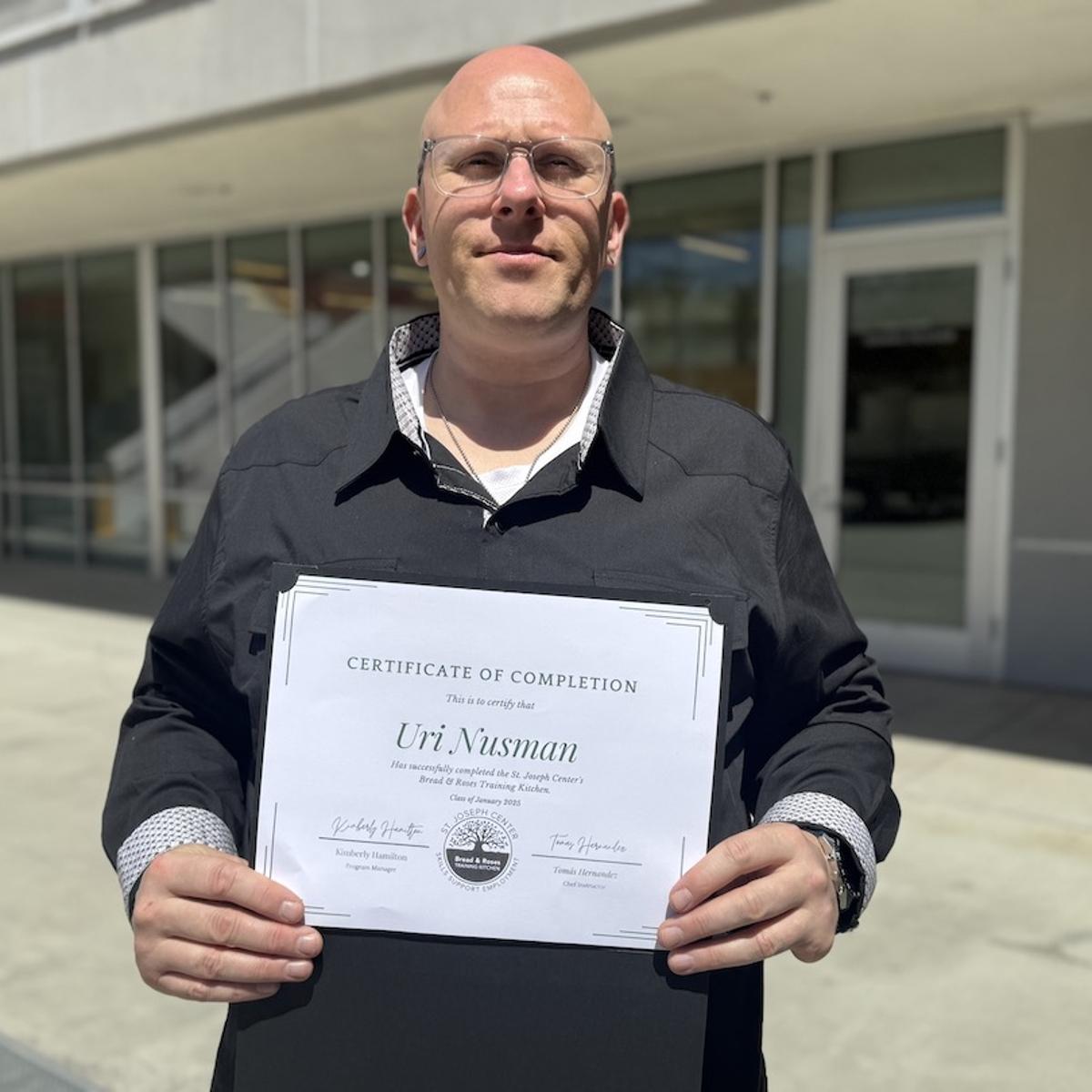
I’m one of the main chefs here, a job I landed after graduating St. Joseph Center’s Bread & Roses Training Kitchen earlier this year. I have the freedom to create whatever menu I want for the residents. I’m not going to cook pork or anything like that—this is a Jewish treatment center—but I do make a mean cholent, an Eastern European beef stew that might as well come from my own mother’s kitchen.
Beit T’Shuvah is located in Culver City. It’s an easy bus ride to SJC HQ and to the cooking classes in Venice. I should know—I occupy one of the beds here. I was a client before enrolling in the Bread & Roses Training Kitchen, and I’d take the bus there for class. “At 43 years old, I’ve been addicted to all sorts of substances. But I’ve been sober for more than a year now.”
Accountability, Faith, and Community
Other than my higher power, I couldn’t have done it without the people at Beit T’Shuvah and SJC. It was actually one of my counselors here, Bridy—her name rhymes with sobriety—who told me about the cooking program. She’d graduated from Bread & Roses herself ten years ago and encouraged me to apply.
A lot of people here hope to get a job, but it’s not so easy. For me, a turning point was resigning—formally—from my warehouse job in Carson. Before that, I’d always been fired or quit by no-showing. Bread & Roses gave me accountability and the confidence to graduate.
Why this facility? I’ve got a felony record in three states. To be honest, the criminality was harder to kick than Crystal Meth itself. I was into the lifestyle—the cars, the money, the women. In recovery, it’s important for me to stay close to my spirituality, though you don’t need to be Jewish to be a client here.
“The criminality aspect was harder to kick than Crystal Meth itself.”
I grew up in a kosher Orthodox Jewish home in Minnesota. Revisiting Judaism without the chaos of an alcoholic father has helped me. Now I can separate the bad from my early experiences, and see that much of what I dismissed wasn’t mumbo jumbo.
We do Torah readings each week here, and I try to bring those lessons into my life. One that spoke to me was about the Israelites preparing the Mishkan, the sacred tabernacle. Everyone had a role to play, big or small, to achieve the larger goal. It’s really about responsibility to community—just like in a kitchen. Chef Tomas, my Bread & Roses instructor, reinforced that lesson for me too.
“We all play a vital role—no matter how insignificant or how major. The same applies in the kitchen.”
Passing It On
The best advice I’d give to someone starting fresh is: give yourself over to those who’ve been there before you. Follow the direction of people who care about you. That’s what I got from Bread & Roses—direction from people who cared, people you don’t have to second-guess.
Back in my hustler days, I loved rolling up on my kids (I have three) with a wad of cash and telling them to grab whatever Nerf guns they wanted at Target. That was my way of buying happiness. These days, they’re just happy I’m doing well after being in and out of prison since 2012. A few months ago my daughter told me, “Dad, my only wish is that you’re free so you can come to my high school graduation.” I was there. What more can I say?
Editor’s note: This post has been edited for length, clarity, and narrative flow.